



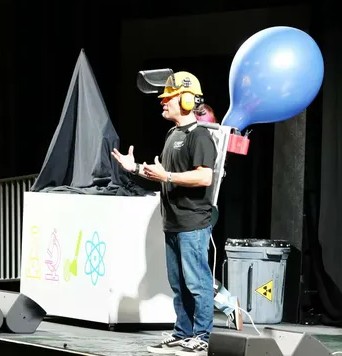
Flight to the Future is an exciting, interactive and sometimes explosive, journey through the discovery and science of flight. Using comedy, audience volunteers and amazing experiments the STEM Response Team explore some of the key discoveries that have made flight possible, the people behind them and the amazing future opportunities that flight holds as humans take their place in the stars!
This show is suitable for upper KS2, KS3, KS4 and KS5, as well as family and community audiences.
Please note: This show contains loud sounds/bangs.
This show is recommended for large venues, festivals and corporate events.
This session links in with the national curriculum in the following ways
- Identify the effects of air resistance, water resistance and friction, that act between moving surfaces
- Describe the sun, Earth and moon as approximately spherical bodies
- Forces as pushes or pulls, arising from the interaction between 2 objects
- Forces: associated with deforming objects; stretching and squashing springs; with rubbing and friction between surfaces, with pushing things out of the way; resistance to motion of air and water
- Similarities and differences, including density differences, between solids, liquids and gases
- The differences in arrangements, in motion and in closeness of particles explaining changes of state, shape and density;
- Pressure in liquids, increasing with depth; upthrust effects, floating and sinking
- Combustion, thermal decomposition, oxidation and displacement reactions
- The use of conceptual models and theories to make sense of the observed diversity of natural phenomena
- The assumption that every effect has one or more cause
- That change is driven by interactions between different objects and systems
- That many such interactions occur over a distance and over time
- That science progresses through a cycle of hypothesis, practical experimentation, observation, theory development and review
- Develop scientific knowledge and conceptual understanding through the specific disciplines of biology, chemistry and physics
- Develop understanding of the nature, processes and methods of science, through different types of scientific enquiry that help them to answer scientific questions about the world around them
- Develop and learn to apply observational, practical, modelling, enquiry, problem-solving skills and mathematical skills, both in the laboratory, in the field and in other environments
- Develop their interest in and enthusiasm for the subject, including developing an interest in further study and careers associated with the subject
- Develop and demonstrate a deep appreciation of the skills, knowledge and understanding of scientific methods
- Develop essential knowledge and understanding of different areas of the subject and how they relate to each other
- Understand how society makes decisions about scientific issues and how the sciences contribute to the success of the economy and society