



The University is committed to providing high-quality educational experience, delivering services with reasonable care and skill and ensuring that applicants and students are treated fairly. This includes providing a fair and transparent policy in respect to the assessment and award of compensation and refunds resulting from action taken under the Student Protection Plan, or from Applicant and Student complaints. This policy has been approved by the University’s Executive Board.
The purpose of this policy is to ensure that applicants and students registered with the University of Wolverhampton are aware of the circumstances in which compensation may be payable or refunds made and procedure for doing so. The policy aims to ensure that decisions are fair, transparent, proportionate and consistent across the University.
The policy supports the University's Student Protection Plan and the Applicant and Student Complaint Procedures and should be read alongside in conjunction with these:
- Student Protection Plan
- Admissions Complaint System: Principles and Procedure
- Student Complaint Procedure
This policy describes:
- The circumstances in which the University will consider financial compensation and/or refunds in relation to measures taken within the terms of the University Protection Plan.
- The circumstances in which the University will consider financial compensation and/or refunds to applicants or students in response to the outcome of a formal complaint.
- How the University will make decisions regarding financial compensation and/or refunds.
The University will seek, wherever possible, to resolve issues by restoring the applicant or student to the position they would have been in had measures under the student protection plan not been required or the issue that was the subject of an upheld complaint not occurred.
Compensation and refunds will only be awarded where there is demonstrable evidence that the University has failed to meet its obligations and that, as a direct result, an applicant or student has experienced a material disadvantage, financial loss, distress or inconvenience which cannot be adequately resolved through other actions. In such cases any proposed financial remedy must be reasonable and proportionate to the circumstances.
Compensation and/or refunds will not normally be awarded where:
- The matter relates solely to academic judgement.
- There is insufficient evidence of loss or impact.
- The applicant or student contributed substantially to the loss or failed to take reasonable action to minimise any losses.
- The issue arose due to circumstances outside the University's control, and the University took reasonable steps to minimise disruption.
- The applicant or student declined reasonable alternative arrangements offered by the University.
- The claim is speculative or relates to hypothetical future losses.
The implementation of this policy is in accordance with the University’s core values which are to be:
- Accountable; we take pride in what we do and how we do it, take responsibility for our actions and operate with transparency and integrity.
- Resilient; we have a positive outlook; we are adaptable and recover from setbacks.
- Inclusive; we are welcoming, respectful, collegiate and supportive.
- Ambitious; we are imaginative, confident, innovative and deliver excellence.
This policy applies to:
- applicants and offer holders
- current students
- students on approved Leave of Absence
- students studying through collaborative provision where the University retains responsibility for the matter under consideration
- former students where a complaint has been accepted under the Student Complaint Procedure
This policy does not apply to claims for refunds that relate to and are covered by alternative policies unless there is a complaint that relates to concerns that the relevant policy has not been followed. Examples include:
- Tuition Fee Liability and Credit Control Policy for Home, Apprenticeship and
Overseas students. - University Accommodation policies
- Claims for financial compensation and/or refunds that have not been submitted through a formal complaint procedure within the published time frames.
- Academic Appeal outcomes.
- Complaints from Members of the Public
For the purpose of this policy, the following definitions apply:
Applicant
An individual who has applied, is applying, or is considering applying for admission to a course of study offered by the University. This includes prospective students, applicants, and offer holders, whether applying directly to the University or through UCAS or another recognised admissions process.
Compensation
A payment made by the University to recognise financial loss, distress, inconvenience, disruption, or loss of opportunity arising from a university act or omission, where the University is satisfied that a non-financial remedy alone is insufficient.
Complaint
An expression of dissatisfaction or concern about a service, action, omission, decision, facility, process, or standard of service provided by the University, where the complainant believes that they have experienced disadvantage, inconvenience, unfair treatment, financial loss, or failure in service provision.
For the purposes of this policy, a complaint must be one that has been considered under the University's Admissions Complaints Procedure or Student Complaints Procedure and has been upheld either in whole or in part. Matters relating solely to academic judgment are not complaints under this policy.
Fee Waiver
A reduction or cancellation of all or part of a fee that would otherwise be payable by a student. This may be applied to tuition fees, accommodation fees, administrative fees, or other charges.
Former student
Former students include individuals who have:
- Graduated
- Been discontinued from their studies.
- Withdrawn from their studies,
or - Otherwise ceased studying
and
- who remain eligible to raise concerns under the terms of the Student Complaint Policy and procedure.
Refund
The repayment of tuition fees, accommodation fees, deposits, or other charges already paid to the University.
Student
An individual who is registered with the University on a programme of study leading to a university award. For the purposes of this policy, this includes:
- students and apprentices currently enrolled on a programme of study
- students and apprentices undertaking placement or work-based learning
- students and apprentices studying through collaborative or partner provision leading to a university award;
- students and apprentices on approved leave of absence
- students and apprentices whose studies have been suspended by the University.
Student Protection Plan
A Student Protection Plan is a document that sets out how a higher education provider will protect students if there is a significant risk that their studies could be disrupted. This could include the closure of a course, the withdrawal from a campus, loss of validation arrangements, or, in extreme cases, the closure of the institution itself.
The primary objective of the Student Protection Plan is to ensure that students can continue and complete their studies in the unlikely event that a course, campus or the university closes. Financial remedies are only considered when reasonable continuation measures, as detailed in the plan, have been explored and where it has been concluded that these measures will not fully protect the students’ ability to continue and complete their studies.
In such cases an offer will be made and there will be no requirement for an applicant or student to submit a separate complaint, unless they are dissatisfied with the remedy that has been offered under the Student Protection Plan.
When action is taken in line with the Student Protection Plan the University will consider financial remedies within the following categories:
- Fee refunds/waivers
- Compensation
Where compensation or a refund is awarded and accepted, future and subsequent claims against the same issue will not be considered by the university.
Fee Refunds/waivers
The University will normally seek to ensure that students are able to continue and complete their studies through alternative arrangements before considering a tuition fee refund. A refund of fees paid, or a waiver of outstanding fees may be considered where the University determines that the measures available under the Student Protection Plan have not been sufficient to avoid material detriment to a student and continuation of study is no longer reasonably possible. A refund may be made directly to the student or, where tuition fees have been paid by Student Finance England, a sponsor, employer or other third party, to the relevant fee payer where appropriate.
Determining the Level of Refund
The University will determine whether a partial or full tuition fee refund is appropriate by considering:
- the proportion of the programme completed;
- the amount of teaching and learning opportunities received;
- the extent to which learning outcomes have been achieved;
- the academic credit already obtained;
- the impact of any disruption on the student's ability to complete their studies;
- any alternative arrangements provided by the University;
- any compensation or other remedy already offered.
Details of circumstances in which full or partial fee refunds/waivers may be considered are listed in Appendix A
Compensation
The University will normally seek to ensure that students are able to continue and complete their studies through alternative arrangements before considering compensation. Compensation may be considered where the University determines that the measures available under the Student Protection Plan have not been sufficient to avoid material detriment to a student and where there is evidence to demonstrate that the applicant or student has experienced:
- material disadvantage
- financial loss
- significant inconvenience
- loss of opportunity
- distress
Compensation will be assessed on the basis of the individual circumstances of each case. Details of circumstances in which compensation may be considered are listed in Appendix B.
Examples of losses that may be considered include:
- Additional travel expenses.
- Additional accommodation costs.
- Relocation costs.
- Additional tuition fees at another provider.
- Professional accreditation costs.
- Visa and immigration costs.
- Childcare costs arising directly from a location or timetable change.
- Reasonable costs associated with transferring to another institution.
- Loss of non-refundable deposits or contractual commitments directly attributable to the Student Protection Plan event.
Compensation will not normally be awarded where:
- The University has successfully implemented alternative arrangements that enable the student to continue and complete their studies without material detriment.
- The student has declined a reasonable alternative offered by the University.
- The costs claimed are speculative or unsupported by evidence.
- The costs arise from personal circumstances unrelated to the Student Protection Plan event.
- The student has already been fully compensated through another remedy.
Determining the Level of Compensation
Appendix C provides compensation band guidance to decision-makers for determining the appropriate level of compensation for disruption, inconvenience, distress or loss of opportunity arising from a Student Protection Plan event. The Compensation Bands are indicative and are intended to promote consistency, fairness and proportionality.
Authorisation
All financial redress proposed as part of action taken in line with the Student Protection Plan must be approved in advance by the Vice Chancellor’s Group.
Fee refunds/waivers and compensation will only be considered where a formal complaint, that has been submitted within the time published limits, via the appropriate University of Wolverhampton Complaint Procedure, has been fully or partially upheld. Formal complaints must be submitted through one of the following procedures (as appropriate):
- Admissions Complaint System: Principles and Procedure - for applicants
- Student Complaint Procedure – for students and recent graduates.
All fee refund/waiver and compensation claims relating to quantified and known financial impacts (such as incurred costs or loss of income resulting from the issue) must be supported by evidence.
Claims relating to unquantified and unknown financial impact will be tested and will require additional evidence and significant substantiation.
Where compensation or a refund is awarded and accepted, future and subsequent claims against the same issue will not be considered by the university.
Determining the Level of Fee Refund/Waiver and/or Compensation
Factors that may be considered when assessing compensation and/or refund awards will include:
- The extent to which the complaint has been upheld.
- Whether processes were followed in accordance with relevant University policies and procedures.
- Any remedy already provided.
- The nature, seriousness and duration of the impact on the applicant/student.
- Evidence of the extent of any financial loss resulting directly from the subject of the complaint.
- Evidence of the extent of any distress and inconvenience directly resulting from the subject of the complaint.
- Actions taken by the University to mitigate or exacerbate the impact.
- Actions taken by the applicant or student to mitigate or exacerbate losses;
- Relevant guidance from the Office of the Independent Adjudicator (OIA).
- Principles of consistency, reasonableness and proportionality.
Decision-makers retain discretion to depart from the indicative ranges where the circumstances of an individual case justify doing so, subject to the approval of the appropriate designated authority.
Compensation Bands:
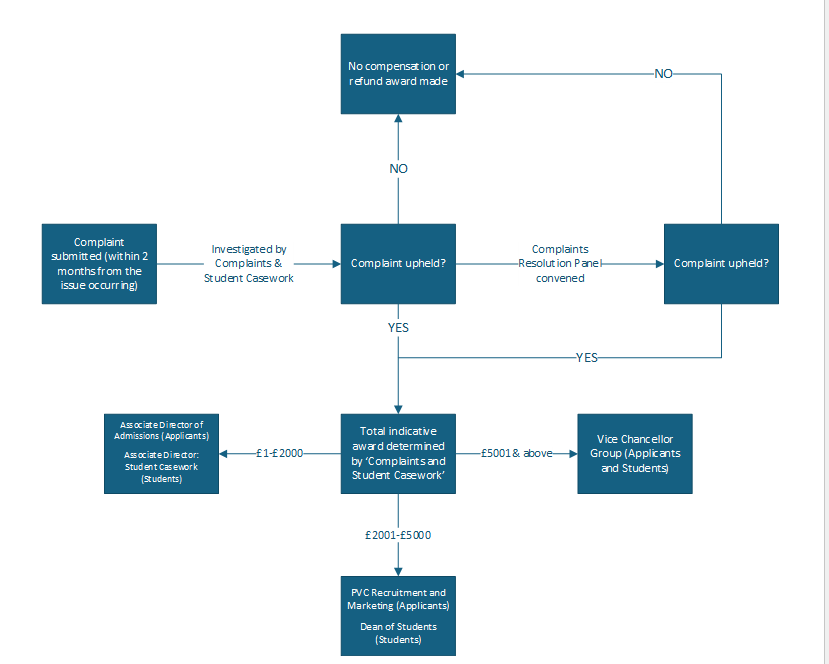
Appendix D provides Compensation Band guidance to decision-makers for determining the appropriate level of financial redress in response to a complaint. These are indicative and are intended to promote consistency, fairness and proportionality.
Authorisation
Any compensation and/or refund proposed as part of the outcome to a complaint, at any stage of the procedure, must be formally approved, in advance, by the designated authority as detailed in Appendix E.
The University will ensure consistent and fair application of the policy, ensuring you are informed of decisions taken in accordance with it. Appendix F outlines the process the university will follow when considering compensation and refund cases.
Applicants and students should thoroughly read this policy, alongside the Student Protection Plan and/or the relevant complaint procedure, to understand how the terms apply to them.
For further support with this policy please contact the ASK@ team in the first instance.
When personal data is expected to be used under this policy, staff must adhere to applicable data protection laws. These are outlined in the University's Data Protection Policy and related policies (https://www.wlv.ac.uk/about-us/corporate-information/wlv-policies/). Any use of personal data should be detailed in the relevant privacy notice and processed in accordance with all data protection principles.
For processing activities that may carry high risk; completion of a Data Protection Impact Assessment (DPIA) may be required. This is determined by answering a series of screening questions included in the DPIA template. The Data Protection Team is available to provide assistance and guidance with any part of this process, please contact them via email: dataprotection@wlv.ac.uk.
Please note that whilst the Data Protection Act does not cover aggregate data, it must be ensured that small numbers held within aggregate data sets do not inadvertently identify individuals.
Training relating to this policy and briefing will be made available in a range of formats according to need.
There are no exceptions to this policy.
This Policy was approved by the University’s Executive Board on 13 October 2026. The University may change this Policy at any time, and where appropriate. Where a policy is not due for review, but is found to require updating, it will remain published, unless the reasons for review render it obsolete.
This policy should be read in conjunction with the following:
For any queries, guidance and support relating to this policy please contact the ASK@ team in the first instance.
|
VERSION |
1.0 |
AUTHOR/OWNER |
Daniel Kidd Dean of Students |
|
Approved Date |
13 October 2026 |
Approved By |
University Executive Board |
|
Review Date |
October 2029 |
|
|
Student Protection Plan
Circumstances in which full or partial fee refunds/waivers may be considered
|
Student Protection Plan Event |
Circumstances where a fee refund/waiver may be considered. |
|
University Closure The University ceases operation permanently |
· the University ceases operation permanently; · the University is unable to continue operating for a prolonged period; and · suitable arrangements cannot be secured to enable the student to complete their studies elsewhere. |
|
Campus Closure or Relocation Teaching is relocated to an alternative location
|
· the relocation results in significant additional burden or disadvantage to the student; · no reasonable alternative arrangements can be implemented; and · as a consequence, the student is unable or reasonably unwilling to continue their studies. |
|
Course Closure A programme of study is closed before the student is able to complete it.
|
· the University is unable to provide a suitable teach-out arrangement; · no appropriate alternative programme can be offered; and · transfer to another provider is not possible or would result in unreasonable detriment to the student. |
|
Loss of Professional Accreditation A programme loses accreditation from a professional, statutory or regulatory body.
|
· the accreditation formed a significant factor in the student's decision to enrol; · the University is unable to provide an alternative route to achieve equivalent professional recognition; and · the student is unable to continue towards their intended professional outcome. |
|
Material Changes to a Programme: Significant changes are made to the content, structure, mode of delivery, location or duration of a programme. |
· the changes substantially alter the programme from that originally advertised; · no acceptable alternative programme is available; and · the student withdraws because the revised programme no longer meets their reasonable expectations. |
|
Loss of Visa Sponsorship Arrangements The University loses its sponsor licence or is unable to sponsor affected international students; |
· transfer or alternative study arrangements cannot be secured; and · the student is unable to continue their studies. |
|
Significant Disruption Resulting in Non-Delivery of Educational Services Substantial elements of a programme cannot be delivered. |
· the University is unable to provide appropriate alternatives; · students are unable to achieve the learning outcomes or award originally contracted for; and · the disruption is sufficiently serious that continuation is no longer reasonably possible. |
|
Failure of Collaborative or Partner Provision A partner institution ceases delivery of a programme. |
· continuation arrangements cannot be secured; · the student is unable to transfer to an alternative location or provider; and · study cannot reasonably continue. |
Student Protection Plan
Circumstances in which compensation may be considered
|
Circumstance |
Examples of potential material losses |
|
Additional Costs Arising from Transfer to an Alternative Provider |
· Higher tuition fees. · Relocation expenses. · Additional travel costs. · Additional accommodation costs. · Professional registration costs. |
|
Additional Costs Arising from Campus or Location Changes |
· Increased travel expenditure. · Increased accommodation costs. · Additional childcare costs. · Additional costs associated with disability support requirements. |
|
Loss of Professional or Accreditation Opportunities |
· A programme loses accreditation. · Students incur additional costs to obtain professional recognition elsewhere. · Students are required to undertake additional study or training. · Students experience a demonstrable loss of a professional qualification pathway. |
|
Material Course Changes |
· Significant disruption to study. · Additional expenditure. · Loss of educational opportunities. · Loss of optional modules, placements, facilities or specialist provision that formed an important part of the original offer. |
|
Substantial Delay to Completion of Studies
|
· Additional living costs. · Additional accommodation costs. · Additional travel costs. · Additional childcare costs. · Delayed entry into employment or professional training. |
|
Inability to Continue Studies |
· Loss of opportunity to complete the course and obtain the qualification |
|
International Students |
· Visa applications. · Immigration processes. · Overseas travel arrangements. · Transfers to another provider. · Additional accommodation commitments. |
|
Partner provider closure |
· Loss and disruption resulting from relocation of teaching, transfers or other alternative arrangements |
|
Distress and Inconvenience Note: This will normally only be considered where the impact exceeds the level of disruption that students could reasonably expect to encounter during higher education study. |
· Significant Distress · Significant Anxiety · Significant Uncertainty. · Significant Disruption. · Significant Inconvenience. |
Student Protection Plan
Compensation Bands
The University will always seek to ensure that students are able to continue and complete their studies through appropriate mitigation measures, including teach-out arrangements, transfer opportunities, alternative delivery methods or alternative locations. Where such measures are not sufficient to avoid material detriment, the University may award compensation in accordance with the following indicative bands.
These bands relate primarily to compensation for disruption, inconvenience, distress, loss of opportunity and adverse impact arising from a Student Protection Plan event. They are separate from any tuition fee refund, tuition fee waiver or reimbursement of actual financial losses, which may also be awarded where appropriate.
|
Band |
Criteria |
Indicative Award |
|
Band A Minor |
Minor inconvenience resulting from a Student Protection Plan event, but student able to continue studies with limited disruption. |
Up to £250 |
|
Band B Moderate |
Noticeable disruption to learning experience requiring additional travel, administrative effort or adjustments. Alternative arrangements in place but the student experiences inconvenience, uncertainty or short-term disruption before normal study arrangements are restored. |
£251 - £500 |
|
Band C Significant |
Substantial disruption arising from course changes, campus closure, relocation or changes to delivery arrangements. The student is able to continue their studies, but experiences significant inconvenience, loss of educational opportunities, additional burdens or financial disadvantage that is not fully addressed through other remedies. |
£501 - £2000 |
|
Band D Major |
Serious detriment. This may include transfer to another provider, loss of specialist facilities, substantial delays to completion, significant changes to course content, or loss of professional opportunities. Although the student is ultimately able to continue or complete their studies, the impact is prolonged and substantial. |
£2,001- £5,000 |
|
Band E Exceptional |
Significant and lasting detriment. Examples may include closure of a course where no suitable alternative exists, loss of accreditation preventing achievement of an intended professional outcome, inability to complete studies as originally planned, or exceptional circumstances resulting in serious financial and educational disadvantage. |
Over £5000 |
Complaints
Compensation Bands
This appendix provides guidance to decision-makers when determining financial compensation, refunds as part of the University Compensation and Refund Policy. This guidance reflects the compensation principles used by the Office of the Independent Adjudicator (OIA).
In all cases compensation will only be awarded where there is demonstrable evidence that the University has failed to meet its obligations and that, as a direct result, an applicant or student has experienced material disadvantage, financial loss, distress or inconvenience which cannot be adequately resolved through other actions.
The Compensation Bands are indicative and are intended to promote consistency, fairness and proportionality. Decision-makers retain discretion to depart from the indicative ranges where the circumstances of an individual case justify doing so, subject to the approval of the appropriate authority as specified In Appendix E.
|
Band |
Criteria |
Indicative Award |
|
Band A Minor |
· Minor administrative errors. · Short delays in communication or decision-making. · Isolated incidents causing limited inconvenience. · Minor procedural failures with little or no lasting impact. · Frustration or inconvenience that is resolved quickly. |
Up to £250 |
|
Band B Moderate |
· Repeated administrative errors. · Delays causing avoidable inconvenience or additional work. · Failure to provide timely information affecting decision-making. · Short-term disruption to studies or University services. · Procedural failures resulting in measurable inconvenience. |
£251 - £500 |
|
Band C Significant |
· Significant service failure. · Extended delays in resolving issues. · Failure to provide agreed support or adjustments. · Loss of educational opportunities with limited long-term consequences. · Material disruption to studies. · Financial losses arising directly from University error. |
£501 - £2000 |
|
Band D Major |
· Serious and prolonged service failure. · Significant disruption affecting progression or completion. · Failure to deliver key aspects of a programme. · Material changes causing substantial detriment. · Loss of professional, placement or research opportunities. · Significant financial loss attributable to University action or omission. |
£2001 - £5000 |
|
Band D Exceptional |
· Exceptional cases involving severe disadvantage. · Course closure where suitable alternatives cannot be provided. · Accreditation loss resulting in substantial loss of expected professional outcomes. · Student Protection Plan events resulting in inability to complete studies. · Severe and sustained service failures with major consequences. · Significant proven financial losses exceeding the lower compensation bands. |
Over £5000 |
* Per complainant
Complaints
Delegated Authority Matrix
|
Compensation Band |
Impact |
Total indicative award* |
Authorised by: |
|
Band A |
Minor |
Up to £250 |
Associate Director of Admissions (Applicants) Head of Student Casework (Students) |
|
Band B |
Moderate |
£251 - £500 |
Associate Director of Admissions (Applicants) Head of Student Casework (Students) |
|
Band C |
Significant |
£501 - £2000 |
Associate Director of Admissions (Applicants) Associate Director: Complaints and Student Casework (Students) |
|
Band D |
Major |
£2001 - £5000 |
PVC Recruitment and Marketing (Applicants) Dean of Students (Students) |
|
Band E |
Exceptional |
£5001 and above |
Vice Chancellor Group (Applicants and Students) |
*This refers to the total cost of the compensation/refund award.
Process for assessment and approval